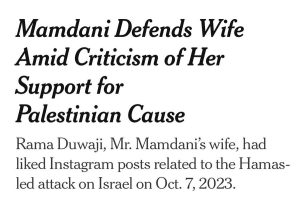
Yeah this is a really bad headline not least because it lumps in “liking” posts celebrating a genocidal act with supporters of the Palestinian cause. pic.twitter.com/fUkJkAZpDM
— Ron Kampeas (@kampeas) March 7, 2026
What The New York Times Talks About When It Talks About “the Palestinian Cause”
Words matter, we’re constantly told—and by “we,” I mean those of us who are readers, writers, educators, and students.
I agree, which is why I have long wondered why more careful attention isn’t given to a phrase that frequently shows up in public discourse, perhaps most notably in The New York Times: “the Palestinian cause.”
In a conflict as painful and divisive as this one, it would seem that any serious outlet would want to be clear and precise in its words. So what exactly does The New York Times mean by “the Palestinian cause”? A popular Palestinian desire for a two-state solution? Or the Palestinian movement, embodied most recently and viciously by Hamas on October 7, 2023, to eradicate Israel from the river to the sea? Or still another definition?
Last week, after the paper again deployed the term in a high-profile news article, I found that I was no longer the only one thinking along these lines. Others were sharing similar concerns on Twitter/X, such as in this post below by Ron Kampeas, who was JTA’s Washington bureau chief for over two decades:
You may be thinking, especially if you are also a writer: Erika, don’t you know that reporters don’t determine their own headlines?
Well, keep reading:
You might also be tempted to tell me: Come on Erika, you need to stop being surprised. This is a longstanding issue at The New York Times. Or, to borrow a popular saying: It’s a feature, not a bug.
And to this, I would have to confess that I’m not surprised. But I am stubborn. And I have been trying to get The New York Times to clarify what they mean by “the Palestinian cause” for a long time.
***
Two years ago, I wrote to journalist Ginia Bellafante—whose “Big City” column in the newspaper’s Metro section I, as a New Yorker, read regularly until it concluded last August—about the very same point. I was responding to a column installment titled “What Columbia Should’ve Learned From ’68,” in which Bellafante referenced calls for Columbia University’s then-president Nemat Shafik to resign “amid the ‘anarchy’ stemming from student demonstrations in favor of the Palestinian cause.”
As an educator with a specialty in Jewish studies, I take pains to caution my own students against absolutes, generalizations, and oversimplifications. This is important because, believe it or not, even undergraduates right here in New York City may have scarce exposure to the richness and diversity of Jewish history and experience. In my courses, I stress, and provide ample evidence, that neither Jews (nor, for that matter, Israelis) are reducible to a single type, background, or belief system. Especially in my literature classes, I remind them that author Chimamanda Ngozi Adichie’s famous warning against “the danger of a single story” holds true across identity groups.
I am admittedly less expert when it comes to Palestinian experience, historical and contemporary. But I know enough to be aware that there, too, multiple communities and outlooks exist. If I didn’t know that to be true—and especially after visiting southern Israel shortly after October 7—I might well succumb to the belief that “the Palestinian cause” writ large is, in fact, synonymous with the terroristic desire to destroy Israel altogether, enacting a true genocide of the nearly eight million Jews now living in the Jewish state alongside about two million non-Jewish citizens.
But as inexpert as I may be, I’m semi-confident that I know more than the average person. For starters, I can find both Gaza and the West Bank on a map; I also know of the rivalries between the Palestinian leadership groups in both places—another fairly significant indicator of the lack of a monolithic “Palestinian cause.” In short, I know enough to understand that the phrase obscures more than it clarifies. I know that in truth, there are multiple “Palestinian causes,” and that some are far less just or noble than others.
Reading Bellafante’s column in the spring of 2024, with so many Israeli hostages (and hostages of other nationalities) still being held captive by terrorists in Gaza, it seemed urgent to try to convey that point to people whose words were appearing in the “paper of record.”
So I sent the following to the email address that I located for Bellafante online:
I’ve enjoyed and appreciated many of your columns in the past. There are a number of issues, however, that I find troubling in the latest one about the anti-Israel protests at Columbia University.
For the moment, I’ll limit myself to one question: What do you understand to be “the Palestinian cause” that you allude to in the second paragraph, and how do the demonstrations at Columbia that you reference in that same paragraph embody support for it?
I’ve seen this phrase before in The New York Times, but today, I am motivated to ask one of the newspaper’s journalists who has used it for a definition. Many thanks for your attention.
I received no response.
***
Thirteen months later, I encountered the following as I read another of Bellafante’s columns:
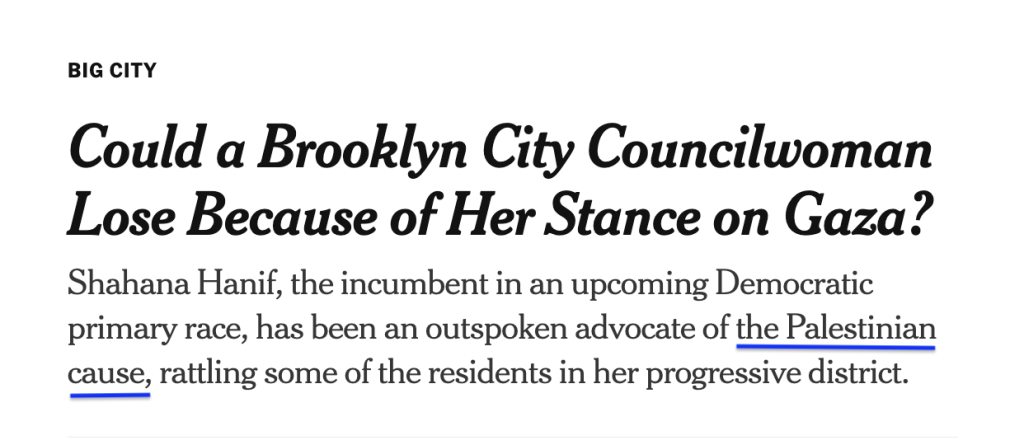
Within the body of the piece, again, Bellafante referenced her subject as “an outspoken advocate of the Palestinian cause.”
And so, again (and this time, copying the Metro Desk), I wrote to Bellafante:
More than a year later, reading your latest column—and in the aftermath of the murder of two Israeli embassy staffers in Washington this week, at the hands of a man chanting “pro-Palestinian” sentiment—I ask you, again, and with more urgency, for clarification regarding the term “the Palestinian cause.”
In the meantime, I will try to continue believing that, contrary to your repeated implications (and those of many of your colleagues), this “cause” is more multidimensional than this language pattern would suggest. Because right now, it is very difficult for me—and, I suspect, for many others among The New York Times‘s Jewish readers and subscribers who seek safety and a better future for both Israelis and Palestinians—to overlook the most malevolent elements that persist in such an ostensibly uniform, easily-(mis)labeled movement.
After reading your column, I found some hope and comfort by listening to a two-part podcast episode featuring Ahmed Fouad Alkhatib (https://www.stateoftelaviv.com/p/s3-e21-ahmed-fouad-alkhatib-from and https://www.stateoftelaviv.com/p/s3-e22-ahmed-fouad-alkhatib-how-october). If I cannot help you and your colleagues understand how much of “the Palestinian cause” has been infected by vicious anti-Israelism, and how important it is for everyone who seeks a better future for all involved to combat this, perhaps he will be more successful.
Once again: no response.
***
Fast-forward to last weekend. Although the “Big City” column has ended, Bellafante remains otherwise engaged at the newspaper. When I saw the attention that the paper’s latest, most prominent use of “the Palestinian cause” was drawing, I thought about my previous outreach.
I considered sending yet another message to Bellafante, but before doing so I rechecked her online profile. There, I noticed something: The email address listed for her there was different from the one I had used in the past.
So this is what I wrote (addressing both Bellafante and the Metro Desk directly):
I am preparing a piece regarding The New York Times’s reliance on the term “the Palestinian cause.” Since this is a matter that I have brought to your attention in the past (to Ginia’s in the messages included below from 2024 and 2025; to the Metro Desk’s only in 2025), I am writing to request clarification and comment. (I am aware, Ginia, that writing this column is no longer part of your portfolio.)
The clarification: Upon reviewing my earlier correspondence, I notice that I used an email address different from the [redacted] address that I have located this weekend on nytimes.com. (I did not, however, receive any error messages when writing to the other address in the past.) I would appreciate clarification as to whether the earlier messages, whether addressed to Ginia Bellafante at the other address OR to the Metro desk, were ever received. All I know at this juncture is that I never received any acknowledgment or response.
I would also like to offer you the opportunity for additional comment on those messages at this time, prior to completing and publishing my piece about the longstanding problem of reliance (by The New York Times and others) on this term, among others.
Thank you for your time and consideration.
I sent this message at 8am Sunday morning, March 8.
Within 20 minutes, I received a response from Bellafante (the Metro Desk has never responded):
Erika, I get dozens of reader emails in conjunction with any column or feature I write and cannot, alas, answer them all. I do not recall if I ever received your original email or not.
Our writing is vetted by a rigorous Standards department and they flag anything they deem inappropriate and ask writers to change the verbiage. The phrase you cite was not flagged by Standards when I wrote that column. So perhaps you should write them and ask for clarification.
I was game to follow this advice, but after spending a fruitless hour trying to locate contact information for “Standards” on NYTimes.com—and exhausting my usually robust set of alternate online search strategies—I had not located any email address.
So I wrote back (yes, again!) to Bellafante explaining that I’d be happy to follow her advice, but would appreciate a tip about how to do so. She responded promptly and helpfully with a suggestion of a name and an email address.
I forwarded the email history to that staffer, who (also promptly) thanked me for writing and told me that he was forwarding the thread to the Communications department, because “all requests for comment go there first.”
I thanked him.
And then I waited.
***
Monday evening, March 9, I received the following from Danielle Rhoades Ha, Senior Vice President, Communications, The New York Times:
Thank you for reaching out.
Our coverage has no political agenda.
No U.S. news outlet has invested more to help readers understand this conflict over the past decade. We have some of the world’s most experienced reporters, photographers and analysts on the ground to ensure our reporting of the conflict is nuanced and steeped in history and expertise.
Your note suggests that phrases like “the Palestinian cause” are a euphemism or a cover for violence. We have used this phrase with context to help our readers understand the complexities of the occupation for decades, pre-dating Oct. 7.
We strive to provide clarity and relevant context in every story.
Through hundreds of interviews and articles and extensive on-the-ground reporting, we have covered the conflict in the Middle East. In the academic sector, this includes the boycotts and demands from protesters for institutions to sever business ties, demands for financial transparency, amnesty for protesters and broader calls for the end of U.S. military aid on behalf of Palestinians. In other situations, we write with specificity about calls for violence and actual violence against Israel and Jews around the world.
We’ve helped readers understand the history of this conflict and its impact across the globe through legal, cultural, religious and personal lenses.
I hope this is helpful.
I did not write back.
Had I done so, I’d likely have begun by thanking Rhoades Ha for the courtesy of the response. But it would have been difficult for me to refrain from adding that I do not, alas, find that response to be “helpful.”
That is because I simply do not share Rhoades Ha’s high opinion regarding her newspaper’s record of covering “this conflict.” I do not believe that The New York Times has consistently “used this phrase [‘the Palestinian cause’] with context”—and trust me, I could share many more examples beyond those that I’ve spotlighted in this already very long, very contextualized piece.
Moreover, given how many times the headline and subhead for the latest article that inspired me to revisit this topic in the first place have been revised since publication (on this, Oren Kessler has done an admirable job attempting to track the changes), I suspect that there may even be at least a few others at The New York Times who may be more willing to acknowledge the legitimacy of my perspective than the Senior Vice President, Communications, appears to be.
Finally, I am most certainly not placated by the item that Rhoades Ha linked to in apparent support of her claim that the newspaper has been using “the Palestinian cause,” as a phrase “with context” in order “to help our readers understand the complexities of the occupation for decades, pre-dating Oct. 7.”
If you click the link, you’ll find that the piece is, indeed, decades-old. It’s dated 2001—when Gaza was occupied by Israel (following an earlier occupation by Egypt—again, I do know something about this history). But it’s been more than 20 years since Israel withdrew from that territory, a decision enacted by the same Ariel Sharon who is mentioned with opprobrium within. For that reason alone—although, in the interest of time and space, I again ask you to believe me when I say that there are others—I do not find the piece in question to be particularly “helpful.”
It may not be helpful—but it’s quite telling. And troubling.
Because if that opinion piece to which the SVP for Communications referred me is The New York Times’s lodestar for understanding “the Palestinian cause,” the newspaper, and all of us who still subscribe to and read it, are in even more serious trouble than I ever suspected.
Words matter.